


Modern high-tech manufacturing facilities face a fundamental constraint: noise control in environments designed for production efficiency, not acoustic performance.
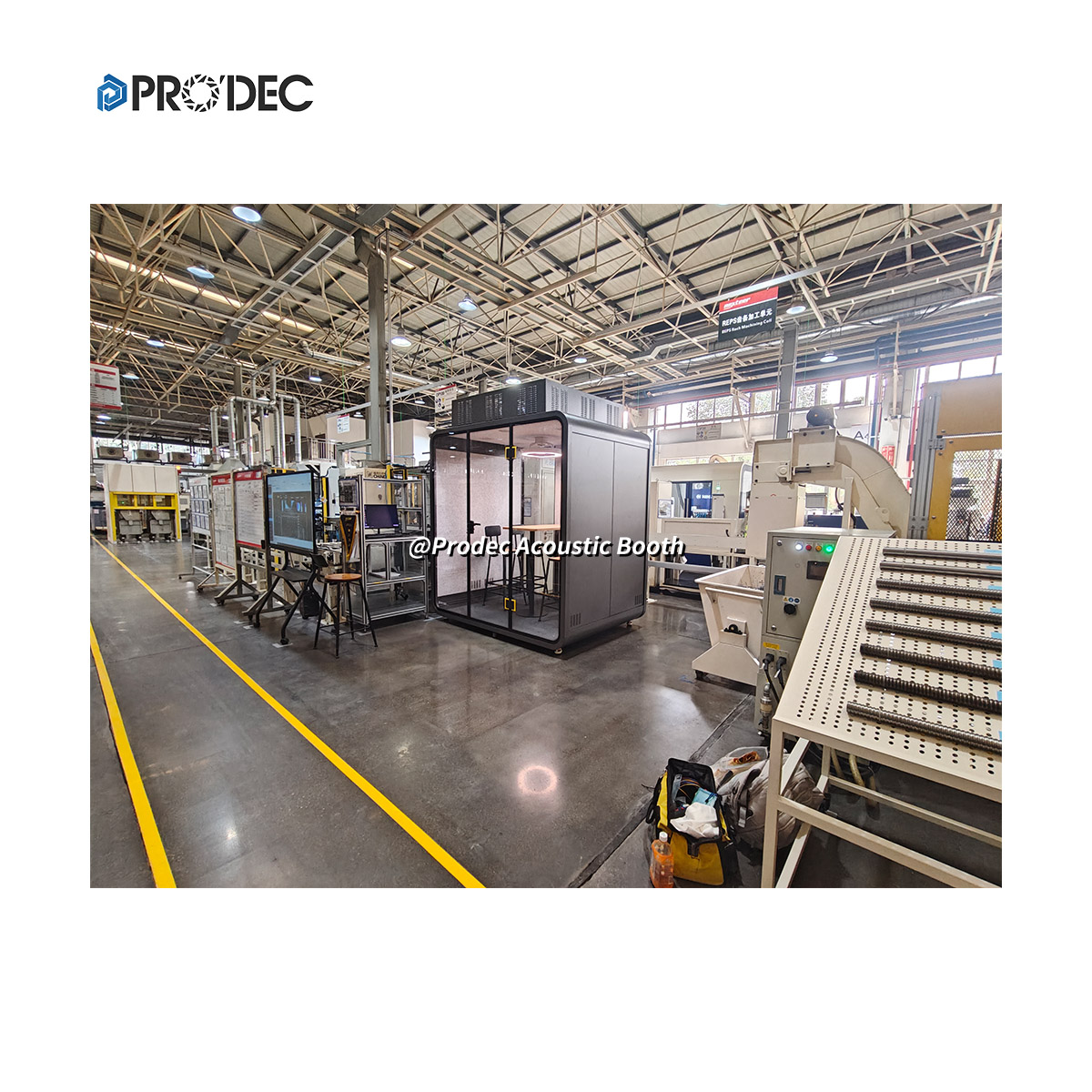
Traditional manufacturing spaces—automotive plants, sensor fabrication facilities, audio equipment factories, microphone manufacturing centers—operate with high ceilings optimized for equipment layout, material flow, and ventilation. This architecture creates an acoustic nightmare. Sound bounces between parallel walls and ceilings, reverberating and amplifying. Noise from production equipment compounds across the entire floor plate. Creating enclosed spaces through conventional partitioning becomes prohibitively expensive and logistically impractical.
Yet precision manufacturing demands quiet environments. Quality inspectors cannot reliably detect audio defects in loud workshops. Engineers designing next-generation products need focus to solve complex technical problems. Assembly technicians working on sensitive components require concentration that constant noise disrupts. Production meetings demand acoustic privacy to discuss competitive strategies.
This is where soundproof acoustic booths provide a paradigm-shift solution. Unlike traditional partitions requiring structural modification, construction permits, and extensive budget allocation, modular soundproof booths deploy in hours, relocate with production layout changes, and cost a fraction of permanent construction.
For high-tech manufacturers operating in high-ceiling environments, soundproof booths aren't optional amenities—they're strategic infrastructure enabling quality, efficiency, and competitive advantage.
The Acoustic Challenge: Why High-Ceiling Factories Create Noise Problems
Understanding the Problem
Traditional manufacturing facilities—automotive component suppliers, electronics assemblers, precision sensor manufacturers—typically feature:
High Ceilings (20-40+ feet): Designed for equipment access, material handling systems, and ventilation requirements. These vertical dimensions are acoustically problematic.
Open Floor Plans: Equipment arranged for production workflow efficiency, not acoustic isolation. Neighboring machines compound noise exposure.
Reflective Surfaces: Concrete floors, metal structural elements, and glass skylights reflect sound rather than absorb it. Noise bounces repeatedly, creating acoustic chaos.
Continuous Equipment Operation: Production demands 24/7 operation. Manufacturing noise never stops, creating constant background acoustic stress.
Why Traditional Partitions Fail in High-Ceiling Environments
When noise becomes a problem, manufacturers instinctively consider conventional solutions: building drywall partitions, installing acoustic panels, or constructing enclosed offices.
This approach encounters immediate barriers in high-ceiling facilities:
Structural Complexity: Creating enclosed spaces in high-ceiling environments requires structural modifications—ceiling systems, load-bearing walls, compliance with building codes. Engineering and construction costs exceed $20,000-50,000 for modest enclosed spaces.
Permitting and Timeline: Building modifications require architectural drawings, permit applications, inspections, and compliance reviews. Timeline extends to 6-12 weeks, during which construction disrupts manufacturing operations.
Production Interruption: Construction noise, vibration, and dust directly impact precision manufacturing. Quality control becomes compromised during renovation. Some manufacturers cannot accept this operational risk.
Inflexibility: Once constructed, partitions are permanent. When production layout evolves—equipment relocation, process optimization, facility expansion—fixed partitions become obstacles. Removing and reinstalling partitions multiplies costs.
HVAC and Electrical: High-ceiling enclosed spaces require dedicated HVAC systems to prevent worker discomfort. Electrical distribution, lighting, and network connectivity must be integrated. These systems add further cost and complexity.
Acoustic Uncertainty: DIY or standard partitions provide unpredictable acoustic performance. Sound travels around, under, and through improperly installed barriers. Investment doesn't guarantee noise reduction.
For manufacturers in high-ceiling facilities, traditional partitioning is often genuinely impractical—not because the concept is flawed, but because implementation is architecturally, economically, and operationally unfeasible.
How Soundproof Booths Solve the High-Ceiling Factory Problem
No Construction, No Disruption
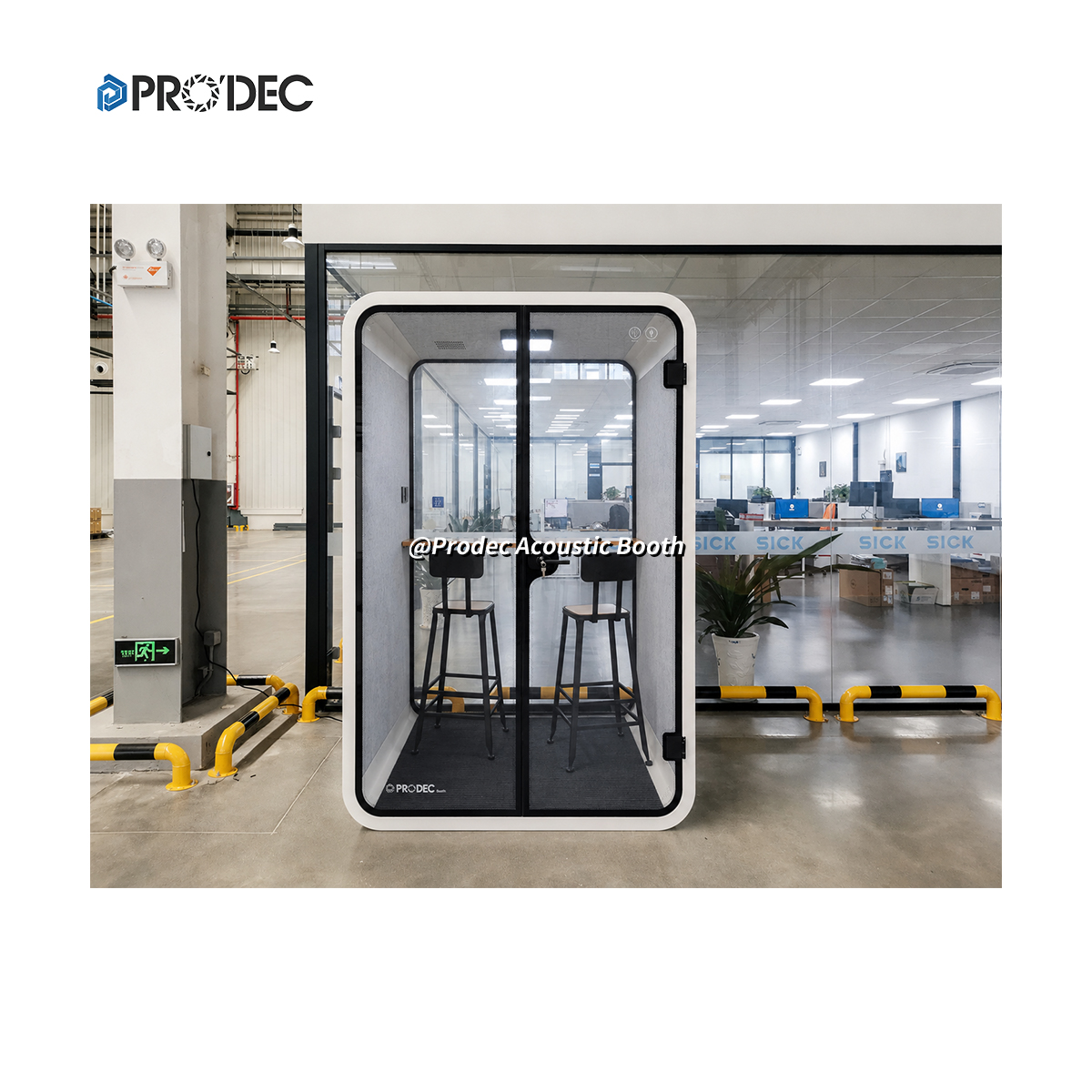
Professional soundproof booths are self-contained, modular units requiring no structural modification:
Installation: Place the booth, level it using adjustable feet, connect standard 100-240V electrical outlet, and verify systems. Total installation time: 2-4 hours. No permits, no construction, no architectural review.
Zero Factory Disruption: Unlike 6-week renovation projects, booth deployment happens during normal operations. Most manufacturers install overnight or during scheduled maintenance windows, allowing continuous production.
Relocation Capability: When production layout changes—equipment repositioning, process optimization, facility reorganization—booths relocate easily. This flexibility protects your investment and adapts to evolving manufacturing needs.
Engineered Acoustic Performance
Unlike DIY solutions, professional soundproof booths deliver consistent, engineered acoustic isolation:
Sound Isolation: Prodec acoustic booths achieve Rw+Ctr 35dB(±5) sound reduction through 38mm double-layer aluminum honeycomb panels with high-density damping material. Manufacturing noise outside becomes essentially inaudible inside.
In Practical Terms: A workshop operating at typical 85-90 dB (loud machinery level) reduces to 50-55 dB inside the booth (normal conversation level). This transformation enables focused work in manufacturing environments where outside noise would make concentration impossible.
Reverberation Control: Interior acoustic treatment (RT 0.25s ±0.1) prevents the echo and harsh reverberations common in industrial spaces. Speech clarity improves, and acoustic quality feels professional rather than industrial.
Complete Functional Integration
Soundproof booths are designed as complete work environments:
Power and Connectivity: Integrated 100-240V outlets and USB charging support laptops, precision measurement instruments, and analysis equipment. Engineers can operate diagnostic tools without extension cords or power limitations.
Lighting: 4000K daylight-temperature LED lighting (150LX) provides illumination appropriate for precision inspection and detailed analysis. Lighting supports extended work sessions without eye strain.
Ventilation: Dedicated ventilation systems with quiet fans provide complete air circulation every three minutes. Manufacturing environments often have variable ambient temperatures; enclosed booth ventilation maintains comfortable conditions.
Environmental Control: Some applications require temperature or humidity stability. Booths can be configured with environmental controls for sensitive inspection or testing applications.
Precision Manufacturing Applications: Where Acoustic Isolation Drives Quality
Automotive Component Manufacturing: Precision in Noisy Environments
Challenge: Automotive suppliers manufacture components with tolerances measured in micrometers. Quality inspectors detect subtle defects through visual inspection, dimensional measurement, and acoustic testing. Manufacturing noise disrupts focus and degrades inspection quality.
Chongqing Naisite Precision Manufacturing Case Study: Naisite, a major automotive drivetrain component supplier, operates a 150,000 sq ft facility with production lines generating continuous 85-90 dB noise. Their quality inspectors initially worked at stationary desks in the open factory floor, surrounded by equipment noise. Inspection error rates ran at 0.8%—slightly above acceptable thresholds.
Naisite deployed four 2-person soundproof booths as dedicated inspection stations. Inspectors moved complex analysis work into quiet environments. Facility ambient noise dropped dramatically—from 85-90 dB outside the booth to 50-55 dB inside.
Results: Inspection accuracy improved to 0.2% error rate (75% reduction in defects). Inspectors reported significantly reduced fatigue and greater confidence in their evaluations. Cost of the solution: four booths at approximately $8,000-10,000 total, installed overnight without production interruption. ROI from prevented warranty claims exceeded solution cost within six months.
Key Insight: For precision manufacturers, acoustic isolation isn't comfort—it's quality assurance. Quiet inspection environments directly translate to fewer defects reaching customers.
Sensor and Electronics Manufacturing: Quality Through Quietness
Challenge: Sensor and electronics manufacturers operate in particularly noisy environments. Automated assembly equipment, soldering operations, and testing systems generate constant acoustic stress. Engineers developing next-generation products need quiet space for concentration and collaboration.
Jiangsu Sike Sensor Manufacturing Case Study: Sike Sensors manufactures industrial-grade sensors for automotive, environmental, and industrial IoT applications. Their 200-person facility operates 24/7, with R&D engineers working adjacent to production floors.
R&D engineers reported difficulty concentrating on complex design problems. Noise from adjacent manufacturing lines disrupted focus. Engineering team meetings in the open office were constantly interrupted by background machinery. Development timelines stretched as engineers struggled to find quiet environments for detailed technical work.
Sike installed six acoustic booths: four single-person configurations for focused engineering work, two four-person booths for collaborative design sessions. Investment: approximately $12,000-16,000 for all units, installed over a weekend.
Results: R&D team reported dramatically improved ability to focus. Design review meetings became more productive. Average development cycle time for new sensors decreased 12-15%. Engineer retention improved noticeably—technical staff reported significantly higher satisfaction with working environment. Engineering leadership attributed the acceleration in product development timelines partly to the acoustic improvement enabling better concentration.
Key Insight: For technology-driven manufacturing, employee experience directly impacts innovation velocity. Quiet environments for engineering work accelerate product development.
Audio Equipment Manufacturing: Acoustic Testing Environments
Challenge: Audio equipment manufacturers—speaker manufacturers, microphone makers, audio interface producers—face a unique acoustic problem: their facilities generate extreme noise. Testing and assembly of audio equipment requires exposure to high-volume sound. Yet quality assurance requires ability to assess subtle audio characteristics in quiet environments.
Professional Audio Speaker Manufacturing Case Study: A established speaker manufacturer operating a 80,000 sq ft facility tested audio products on production floors with ambient noise 95+ dB. Quality assurance engineers needed to assess speaker response characteristics, frequency balance, and defect detection—all requiring ability to hear minute acoustic details.
The facility installed two dedicated acoustic testing booths with professional audio monitoring equipment: one 2-person booth for routine quality assessment, one 4-person booth for collaborative audio engineering analysis.
Acoustic Performance: Outside the booth, ambient noise 95+ dB. Inside, reduction to approximately 60 dB enabled accurate listening assessment. Engineers could evaluate subtle characteristics impossible to detect in the surrounding noise.
Results: Audio quality assessment became measurably more reliable. Defect detection capability improved. Speaker tuning quality improved noticeably. Customer returns related to audio quality decreased measurably. Most importantly, quality assurance engineers experienced dramatically reduced occupational acoustic stress—they no longer required daily noise dosimetry or hearing protection when conducting quality assessments.
Key Insight: Audio equipment manufacturers face a distinctive acoustic challenge. Professional soundproof booths enable quality assessment that simply cannot happen in manufacturing noise.
Microphone Manufacturing: Precision in Acoustic Measurement
Challenge: Microphone manufacturers must verify acoustic sensitivity, frequency response, and defect characteristics through careful measurement in controlled acoustic environments. Standard manufacturing facilities cannot provide the acoustic control necessary for precision microphone testing.
Professional Microphone Manufacturer Case Study: A specialized microphone manufacturer producing broadcast and studio microphones operates comprehensive acoustic testing. Initial testing occurred in makeshift spaces—isolated corners of the facility, borrowed conference rooms, or external facilities, complicating quality control workflows.
They deployed four single-person soundproof booths as dedicated acoustic measurement stations, each equipped with precision audio measurement equipment and calibrated microphones. Investment: approximately $7,500-9,000 total.
Results: Acoustic testing moved from ad-hoc distributed locations to systematic standardized booths. Measurement consistency improved. Test-to-test variability decreased (more accurate sensitivity reporting). Manufacturing throughput improved because testing became faster—engineers no longer wasted time locating suitable testing space.
Key Insight: Precision acoustic measurement requires controlled environments. Soundproof booths transform measurement capability from aspirational to reliable.
Cost-Benefit Analysis: Soundproof Booths vs. Traditional Partitions
| Factor | Traditional Partition Construction | Soundproof Booth Solution |
|---|---|---|
| Initial Installation Cost | $20,000-50,000+ per enclosed space | $1,880-4,400 per booth |
| Implementation Timeline | 6-12 weeks (architectural, permits, construction) | Hours to 1-2 days |
| Production Disruption | Significant (construction, dust, vibration) | Minimal (overnight installation) |
| Structural Modification | Extensive (walls, HVAC, electrical) | None required |
| Permits and Approvals | Required (building permits, inspections) | Not required |
| Flexibility and Relocation | Permanent fixed installation | Fully relocatable |
| Acoustic Performance | Variable (depends on installation quality) | Engineered, consistent 35dB reduction |
| Space Efficiency | Consumes usable factory floor space | Compact footprint, minimal space impact |
| Scalability | Expensive to expand (more construction) | Add booths incrementally |
| Investment Protection | Cannot relocate if facility changes | Portable—protects investment through layout changes |
Example Scenario: A 100,000 sq ft manufacturing facility needs four dedicated quiet spaces (inspection, engineering, testing, meetings).
Traditional Approach:
Cost: 4 × $25,000 = $100,000
Timeline: 12 weeks disruption
Flexibility: Permanent; cannot relocate
Soundproof Booth Approach:
Cost: 4 booths × $3,000 avg = $12,000
Timeline: 1-2 days setup
Flexibility: Fully relocatable; invest in scalable capacity
Savings: $88,000 and 11 weeks of disruption avoided, with superior flexibility.
Step-by-Step: Deploying Soundproof Booths in Manufacturing Facilities
Step 1: Identify High-Impact Needs
Assess where quiet environments directly improve manufacturing outcomes:
Quality Inspection: Precision visual/acoustic analysis
Engineering Workspaces: Design, analysis, problem-solving
Testing Areas: Acoustic, environmental, or precision measurement
Collaborative Spaces: Product development discussions, management meetings
Sensitive Operations: Work requiring concentration and freedom from distraction
Step 2: Quantify Current Challenges
Document how noise currently impacts operations:
Inspection error rates: Do noisy environments correlate with quality issues?
Engineer productivity: Do employees report difficulty concentrating on complex technical work?
Meeting effectiveness: How frequently are discussions interrupted by background noise?
Occupational health: Do employees report hearing-related fatigue or stress?
Step 3: Determine Booth Configuration
Match booth sizes to actual needs:
Heavy Individual Work: Emphasize S-pods (single-person) for focused analysis
Small Team Collaboration: Focus on M-pods (2-person) and L-pods (4-person)
Large Group Meetings: Include XL-pods (6-person) for management discussions
High-tech manufacturers typically benefit from mixed configurations—several single-person booths for focused work, complemented by 2-4 person options for collaboration.
Step 4: Select Strategic Locations
Position booths for maximum accessibility:
Quality Areas: Near inspection workstations, testing equipment
Engineering Zones: Proximity to R&D offices and workbenches
Central Locations: Accessible to all departments that need acoustic isolation
Natural Walkways: Visible, high-traffic areas encourage usage
Step 5: Plan Power and Infrastructure
Ensure booth locations support required systems:
Electrical: Standard 100-240V outlet availability
WiFi/Network: Strong connectivity for laptops and analysis equipment
Equipment Access: Proximity to shared measurement instruments or testing apparatus
Environmental: Consider facility temperature/humidity if climate control required
Step 6: Establish Usage Protocols
Create simple guidelines that encourage utilization:
Open Access: First-come-first-served (no advance booking)
Flexible Duration: Support both quick 15-minute focus sessions and multi-hour analysis work
Professional Use: Reserve for work requiring concentration—inspection, analysis, design, testing
Facility Maintenance: Simple end-of-shift cleanliness standards
Step 7: Deploy with Minimal Disruption
Install during maintenance windows or overnight:
Timing: Schedule installation outside production hours if possible
Setup: Professional installation handles positioning, leveling, electrical connection
Testing: Verify systems function before releasing booths for use
Step 8: Communicate Purpose and Usage
Educate workforce about acoustic benefits:
Problem Framing: Explain how noise impairs inspection quality, engineering focus, or decision-making
Booth Purpose: Clarify that booths are strategic quality/productivity tools, not privileges
Open Access: Emphasize first-come-first-served availability—anyone working on noise-sensitive tasks can use
Usage Examples: Share specific examples of work that benefits from quiet environments
Step 9: Monitor Impact on Quality and Productivity
Track measurable improvements:
Inspection Accuracy: Do defect detection rates improve?
Engineer Productivity: Do development timelines accelerate?
Employee Satisfaction: Do surveys indicate improved workplace experience?
Utilization Rates: Which booths see highest usage?
Step 10: Scale Based on Demonstrated Value
Use initial deployment results to guide expansion:
High Utilization (>80%): Deploy additional booths of the same configuration
Specific Needs: Add booth types based on actual usage patterns
Department Expansion: Extend acoustic booth access to additional teams
Real Manufacturing Professional Perspectives
Quality Assurance Director
"Our inspection error rates were running high despite experienced staff. We finally realized that constant manufacturing noise was degrading our inspectors' ability to concentrate. Deploying soundproof booths as dedicated inspection stations transformed results. Defect detection accuracy improved dramatically. More importantly, our inspectors report significantly reduced fatigue—they're not battling acoustic stress all day. The acoustic solution cost less than one major customer quality issue would have cost us in liability."
Manufacturing Engineering Manager
"We operate in a high-noise facility where finding quiet space for technical analysis was nearly impossible. Our engineers were borrowing conference rooms, working irregular hours, or worse—trying to focus on complex problems in 90dB noise. We deployed soundproof booths specifically for engineering collaboration. Design cycle times improved noticeably. I attribute acceleration partly to engineers being able to focus deeply on technical problems rather than competing with manufacturing noise. It's one of the best facility investments we've made."
Operations Director
"We needed quiet inspection and testing spaces but traditional construction was prohibitively expensive and operationally disruptive. Soundproof booths were a revelation—they deployed in hours without interrupting production, cost a fraction of permanent construction, and remain flexible as our facility evolves. From an operations perspective, they're perfect: minimal disruption, clear ROI from improved quality metrics, and no regret if facility requirements change."
Audio Equipment Quality Engineer
"Audio equipment assessment requires ability to hear subtle characteristics impossible to detect in manufacturing noise. Before acoustic booths, we conducted testing in ad-hoc spaces—borrowed offices, external facilities—creating logistical nightmares. Now we have dedicated acoustic testing stations. Measurement consistency improved dramatically. More importantly, working in quiet environments rather than constant noise eliminated occupational stress I didn't realize was affecting me."
FAQ: Soundproof Booths for Manufacturing Environments
How much noise reduction do soundproof booths actually provide in high-noise manufacturing environments?
Professional soundproof booths achieve Rw+Ctr 35dB(±5) sound reduction through engineered construction: 38mm double-layer aluminum honeycomb panels with high-density damping material. In manufacturing environments operating at 85-90 dB, this reduces interior noise to 50-55 dB—a 35-40 dB reduction—enabling normal conversation and concentration. For reference, 50-55 dB approximates a quiet office; 85-90 dB approximates a noisy factory. The acoustic isolation is substantial and measurable.
Can soundproof booths be integrated with manufacturing equipment or measurement systems?
Yes. Booths can accommodate integrated workstations for precision measurement equipment, audio analysis systems, or diagnostic tools. Power outlets and connectivity support measurement instrumentation. Some manufacturers integrate specialized lighting for inspection work or environmental controls for sensitive measurements. Acoustic booths function as complete work environments, not empty enclosures.
What happens to ventilation in soundproof booths during extended use?
Dedicated ventilation systems with quiet fans provide complete air circulation every three minutes. Multiple sound barriers in airflow tunnels minimize fan noise while maintaining fresh air supply. Manufacturing environments often have variable ambient temperatures; booth ventilation maintains comfortable conditions during multi-hour work sessions. Occupants don't experience stuffiness or discomfort from extended occupancy.
How do soundproof booths compare to hearing protection devices (earplugs, earmuffs)?
Hearing protection devices reduce personal exposure but don't address underlying problems: workers still operate in noisy environments, communication remains difficult, and cognitive load from noise stress persists. Soundproof booths eliminate the noise source for critical work activities—inspection, analysis, collaboration—eliminating both exposure and stress. Hearing protection is important for manufacturing floor operations; acoustic booths complement protection by eliminating noise from sensitive work tasks.
Can soundproof booths be relocated if production layout changes?
Yes—this is a key advantage. Booths are self-contained modular units that relocate easily as production lines shift, equipment repositions, or facility layouts evolve. Unlike permanent partitions, acoustic booths remain valuable assets even as manufacturing requirements change. This flexibility protects your investment long-term.
What maintenance do soundproof booths require?
Minimal. Durable aluminum and acoustic materials are designed for industrial environments. Most facilities establish simple end-of-shift cleanliness standards. High-use booths might benefit from professional acoustic panel cleaning monthly or quarterly. No specialized maintenance is required—they function reliably with basic facility care.
How do soundproof booths affect occupational health and safety compliance?
Soundproof booths support compliance by enabling noise-sensitive tasks to occur in controlled acoustic environments. They don't replace required hearing protection on manufacturing floors, but they reduce overall noise exposure for employees working on inspection, quality assurance, or engineering tasks. This supports occupational health by reducing cumulative noise exposure and work-related acoustic stress.
Conclusion: Strategic Infrastructure for Precision Manufacturing
High-tech manufacturing—automotive components, sensors, audio equipment, precision electronics—success depends on quality, innovation, and operational excellence. Each is impaired by the acoustic chaos inherent in high-ceiling manufacturing facilities.
Traditional approaches—partitions, acoustic panels, enclosed offices—are often impractical in high-ceiling environments. Structural modification costs exceed $20,000-50,000, timelines extend 6-12 weeks, and production disruption is substantial. For many manufacturers, traditional solutions are simply not feasible.
Soundproof acoustic booths provide a transformative alternative. Case studies from Chongqing Naisite, Jiangsu Sike Sensors, audio equipment manufacturers, and microphone specialists demonstrate measurable improvements: enhanced inspection accuracy, accelerated engineering development, improved quality assurance, and reduced occupational stress.
The financial logic is compelling. Soundproof booths cost a fraction of traditional construction, deploy in hours, require no permits or structural modification, and remain relocatable as manufacturing needs evolve. For precision manufacturers, acoustic booths aren't optional amenities—they're strategic infrastructure investments directly supporting quality, innovation, and competitive advantage.
The question isn't whether manufacturing facilities need quiet environments for critical work. They do. The question is whether manufacturers will pursue expensive, disruptive traditional construction or deploy strategic acoustic booth infrastructure that provides superior flexibility, faster implementation, and better long-term value.
For high-tech manufacturers operating in high-ceiling facilities, the answer is clear: soundproof acoustic booths represent infrastructure investment that enables quality, accelerates innovation, and protects long-term facility flexibility.
Ready to transform your manufacturing facility's acoustic environment?
Explore Prodec Acoustic Booth manufacturing solutions or contact us to discuss configurations tailored to your facility's specific quality, engineering, and testing requirements.